Introduction
If you're marketing crypto-assets in the EU, you've already felt the weight of three letters: M‑I‑C‑A. The Markets in Crypto-Assets Regulation rewrites the rulebook, and Article 6 sits right at the heart of it. It's not about flashy ad copy or tweet length—it's about the white paper, the single most important disclosure document you'll ever publish.
But here's the good news: understanding Article 6 doesn't mean killing your creativity. In fact, once you know what must be said—and what must never be promised—you can build campaigns that are both auditable and magnetic. This post breaks down exactly what Article 6 requires, then gives you actionable (and compliant) creative strategies. And we'll show you how MiCA Check can transform this from a compliance headache into a seamless part of your workflow.
What MiCA Article 6 Actually Says (in plain English)

Article 6 mandates that before any offeror makes a crypto-asset available to the public in the EU, they must draw up, notify, and publish a white paper. The white paper must contain, at a minimum:
- A clear statement that the crypto-asset is not covered by investor compensation schemes or deposit guarantee schemes under EU law.
- A fair, clear, and not misleading description of the offeror, the project, the rights attached to the crypto-asset, and the risks involved.
- Information about the offer price, the time frame of the offer, and any hard cap or other conditions.
Why does this matter for marketers? Because every marketing communication about a crypto-asset must be consistent with the white paper. If your tweet promises something the white paper contradicts, you're in breach. If your blog post omits the "not protected" disclaimer, you're non‑compliant. MiCA doesn't just regulate the white paper itself—it makes the white paper the single source of truth for all marketing.
Key takeaway: Article 6 means your marketing materials are legally tethered to the white paper. Get the white paper right, and your marketing can breathe freely within that framework.
Why Compliance Doesn't Mean Boring
Many marketers fear that MiCA will reduce their copy to sterile, lawyer‑approved robots. That's a myth. The regulation doesn't ban persuasive language—it bans misleading language. You can still:
- Highlight your product's unique features.
- Use storytelling and testimonials (as long as they're genuine and not misleading).
- Show community excitement and real‑world use cases.
- Emphasize technological innovation.
The trick is to anchor all creative claims in the white paper's factual disclosures. If the white paper states that the token offers governance rights, you can say "Shape the future of the protocol." If the white paper says there's no guaranteed return, you never utter "Earn passive income." It's that simple.
5 Creative‑Yet‑Compliant Marketing Tips
Here's how to craft MiCA‑safe content that still converts.
1. Turn white paper excerpts into social proof — pull direct, tangible facts from the white paper and use them as visual quotes. For example, if the white paper mentions a partnership with a known firm, share that as a clean, verifiable graphic. This keeps your claims truthful and easily traceable back to the disclosure document.
2. Use conditional language as a creative tool. Words like "may," "could," and "potential" aren't weasel words — they're compliance tools that also build intrigue. "Holders may gain access to future airdrops (subject to eligibility)" is both exciting and secure. It sets realistic expectations while keeping the reader curious.
3. Design "Risk‑First" visuals — place mandatory risk warnings (like "Crypto‑assets are not covered by deposit guarantee schemes") directly on images, thumbnails, and video headers. This makes the visual self‑contained and compliant if shared out of context. MiCA Check can automatically validate whether your imagery includes these disclaimers and whether they're readable.

4. Create an interactive white paper hub — Instead of hiding the white paper behind a tiny link, build a content hub that mirrors its structure. Blog posts, FAQs, and explainer videos all become marketing assets that are inherently consistent with the white paper. Each piece can then be promoted safely.
5. Run MiCA compliance simulations — before any post goes live, simulate how the MiCA Check analyzer would score it. This is where MiCA Check shines—it flags non‑compliant phrasing, missing disclaimers, and white‑paper inconsistencies in seconds, letting you iterate until your content is both punchy and bulletproof.
Meet MiCA Check, Your AI‑Powered MiCA Compliance Assistant
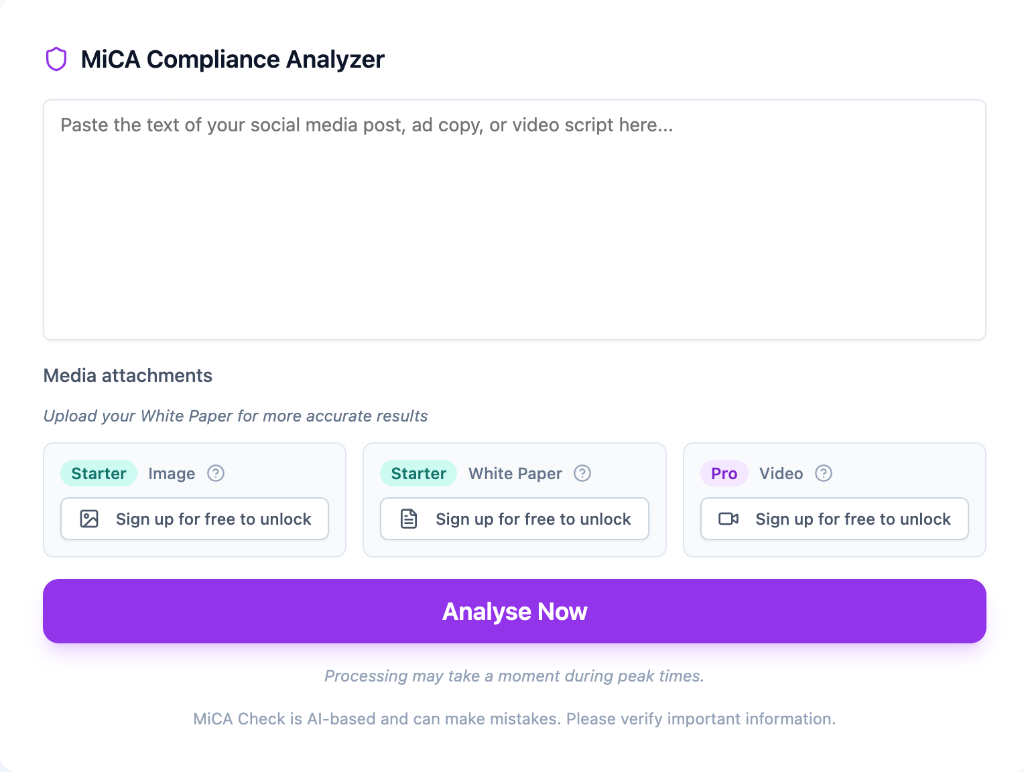
You don't need to memorize every sub‑paragraph of Article 6. MiCA Check does the heavy lifting for you.
- Instant compliance scoring – Upload any text or image and get a score (0‑100) with a full breakdown.
- White paper alignment – Verify that your marketing materials stay consistent with your notified white paper.
- Automatic rewrite suggestions – See exactly how to fix risky phrases while preserving your voice.
- Visual disclaimer detection – Know whether your images carry the required warnings.
Whether you're drafting a tweet, a landing page, or a 30‑minute AMA script, MiCA Check helps you publish with confidence after internal approval. It also has a documented trail of communication with your colleagues. It's the creative marketer's safety net.
Final Thought
MiCA Article 6 isn't a creativity killer; it's a structural requirement that, when honoured, actually strengthens your marketing. When every claim you make is traceable, truthful, and accompanied by the right disclaimers, you build long‑term trust—and trust is the best converting asset in crypto.
So go ahead: tell your story, showcase your innovation, and design bold campaigns. Just let MiCA Check be the co‑pilot that helps keep them compliant.